

Movable Partition Wall Flexible Spaces
Today, rapid changes due to time have made it necessary for spaces to adapt quickly to this change. Achieving this rapid change and adaptation depends on the flexible construction of the structure. Recently, the concepts of “Flexibility” and “Flexible Space” have been widely discussed in the architectural environment.
The most important concept that emerged in order to ensure the correct relationship between user needs and space and to adapt the spatial organization to the changing conditions, functions and techniques in the process is the concept of "flexibility". Flexibility can be defined as the maximum adaptation of the space depending on the changes and developments in the process, meeting the changing demands effectively, thus keeping the quality value at a high level throughout life. However, many definitions have been made on the concept of "Flexibility" in history.
Some of the definitions of “Flexible Space” made by architects in history:
Weeks(1964): Indeterminate architecture is that the form of the building is not tied to any function or capacity.Collins(1965): A closed loop specialized for multiple configurations, not one, specified by the architect.
Turan(1974): It is the capacity to reorganize and expand while preserving the general order of structural components.
Tapan(1972): It is the ability of the same design unit to respond to different user needs without changing the building system and the opportunity to use the same volumes for more than one function.
Atasoy(1973): It is based on variability and the satisfaction of changing needs with minimal effort.
Oxman(1975): Changeability, expansion, adaptability to changing conditions.
Yürekli(1973): It is the ability to change shape with the ability to return to its original form, to change constantly or in constant harmony with the Being change.
Maccreanor(1998): Flexibility is a design idea that leads to the breakdown of traditional arrangements, which does not mean the need for endless change and the breakdown of something in particular.
Forty(2000): It is an illusion that gives architects future control over their structures.
Friedman(2002): Mobility and individual freedom.
Schnieder, Till(2007): It is the ability to cause physical changes in the structure.
Habraken(2008): Different spatial arrangement, adaptation, variety of uses and freedom.
Hertzberger(2009): It is a system for finding neutral solutions to specific problems.
Kronenburg(2011): It is the integrated attitude of current requirements with possible future changes and freedom of use.
In the light of all these discussions, architectural design flexibility is the ability of a building to meet the requirements that result from changes according to user, time, technology, and function. The essence of flexibility is the maximum adaptability of the design to the changing needs of the user.
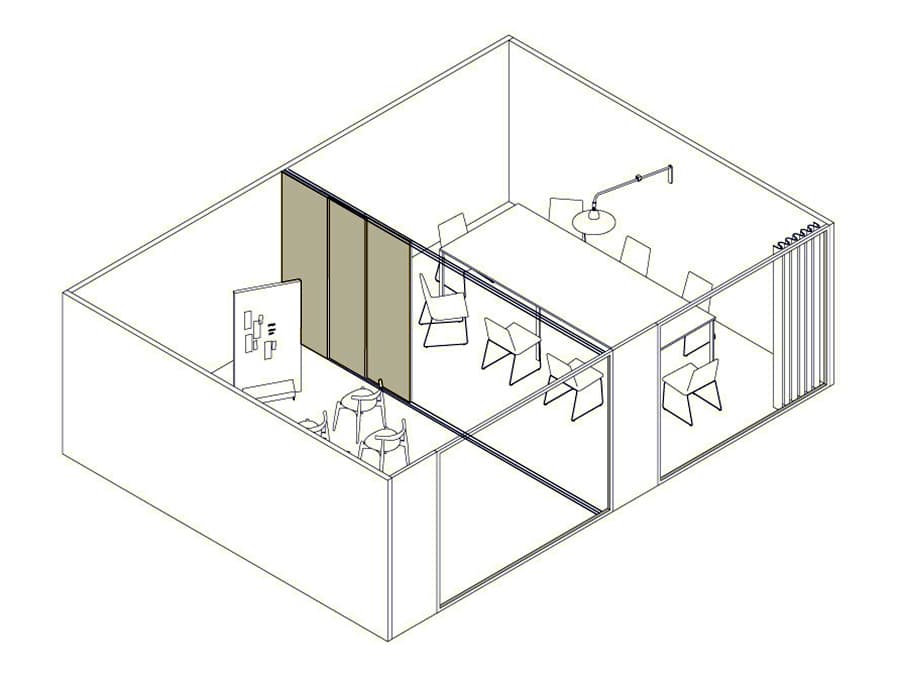
The concept of flexibility is now indispensable for contemporary design. One of the most practical ways to create flexible and multifunctional volumes, which is one of the requirements of contemporary interior design, is to use movable surfaces in space design. With the Movable Partition Wall Systems used in the organization of the spaces, it becomes possible to prepare your spaces for the changing conditions of time.
Source:
http://www.mimarlikdergisi.com/index.cfm?sayfa=mimarlik&DergiSayi=404&RecID=3958Islamoglu, O. and Usta, G. (2018) A Theoretical Look at Flexibility Approaches in Architectural Design
https://yapidergisi.com/cagdas-mimaride-esnek-mekanlarin-izinde/ https://www.etimolojiturkce.com/kelime/esnek
